
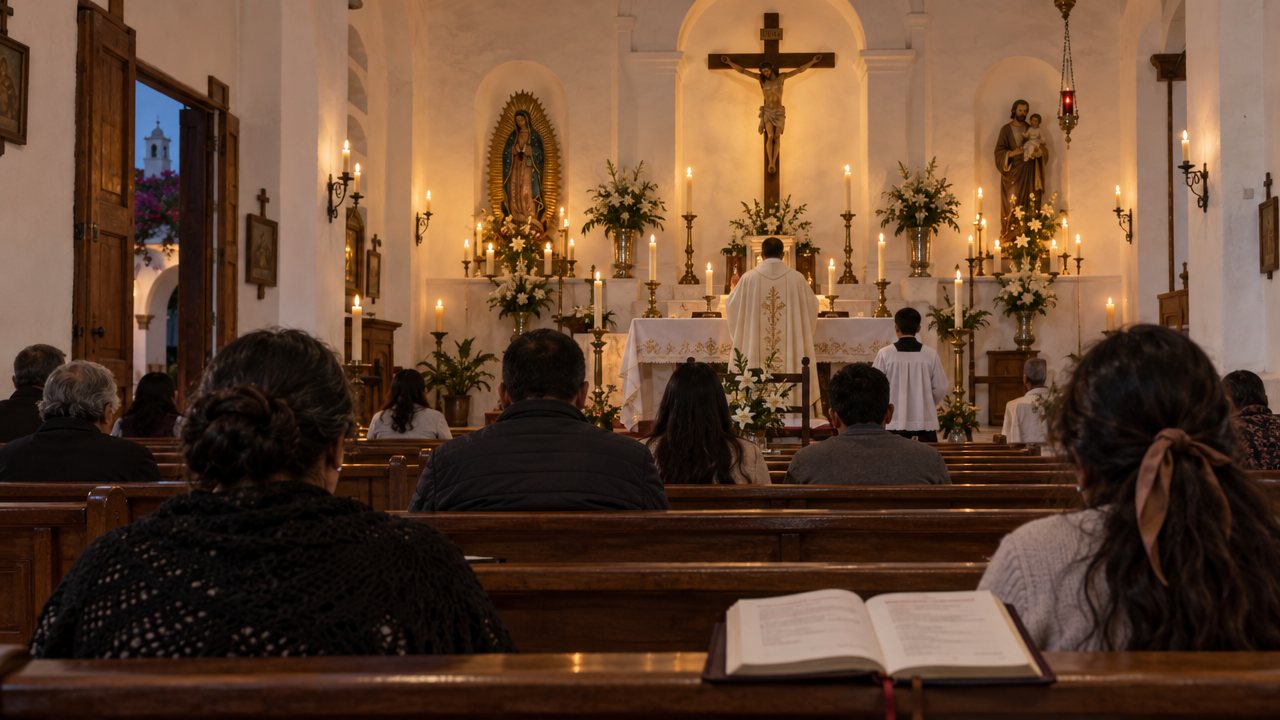
You can follow a Catholic Mass in Spanish in Los Cabos even if your Spanish is basic, because the order of Mass is identical in every language. Learn a handful of responses, arrive a little early and dress modestly, and you will feel at home in any parish from Cabo San Lucas to San José del Cabo.
This guide walks through the Mass step by step with the Spanish you will hear, the responses to say, how Communion works and the small courtesies that local parishioners appreciate. If you would rather attend in English, start with our guide to Catholic Mass in English in Los Cabos.
Key facts
- The order of Mass is the same in Spanish as in English, so you can follow along even without much Spanish.
- Most parishes in Los Cabos celebrate Mass in Spanish; Sunday evening Masses (6:00 to 8:00 p.m.) are common.
- Key responses: “Y con tu espíritu” (And with your spirit), “Amén”, “Te alabamos, Señor” and “Demos gracias a Dios”.
- Church law asks Catholics to fast for one hour before Communion (canon 919); visitors from other traditions are welcome to come forward for a blessing or remain seated.
- Dress modestly: covered shoulders, no swimwear, hats off inside.
Why are most Masses in Los Cabos in Spanish?
Los Cabos belongs to the Catholic Diocese of La Paz, and its parishes serve local Mexican families first. In our church directory, almost every Catholic parish lists Spanish as its language, and most celebrate their main Sunday Masses in the evening, often between 6:00 and 8:00 p.m., when the day has cooled. English or bilingual Masses exist, but they are few and often seasonal.
The good news is that a Spanish Mass is not a foreign experience for a Catholic visitor. The readings follow the same worldwide calendar, so the Gospel you hear in Cabo on a given Sunday is the one being read in your home parish.
What is the order of Mass, and what will I hear in Spanish?
Here is the Mass in order, with the main lines the priest says and the response the congregation gives.
Introductory rites
- Sign of the Cross: “En el nombre del Padre, y del Hijo, y del Espíritu Santo.” Response: “Amén.”
- Greeting: “El Señor esté con ustedes.” Response: “Y con tu espíritu.” (And with your spirit.)
- Penitential act (“Yo confieso…”), then the Señor, ten piedad (Lord, have mercy) and, on Sundays outside Advent and Lent, the Gloria.
Liturgy of the Word
- After each reading: “Palabra de Dios.” Response: “Te alabamos, Señor.” (Thanks be to God.)
- Before the Gospel: “Lectura del santo Evangelio según san…” Response: “Gloria a ti, Señor.”
- After the Gospel: “Palabra del Señor.” Response: “Gloria a ti, Señor Jesús.”
- The homily, then the Creed (Credo) and the Prayers of the Faithful, usually answered with “Te rogamos, óyenos” (Lord, hear our prayer).
Liturgy of the Eucharist
- “Levantemos el corazón.” Response: “Lo tenemos levantado hacia el Señor.” (We lift them up to the Lord.)
- “Demos gracias al Señor, nuestro Dios.” Response: “Es justo y necesario.” (It is right and just.)
- The Santo (Holy, Holy), the Eucharistic Prayer and the great “Amén”.
Communion rite
- The Padre Nuestro (Our Father). Many Mexican congregations hold hands or raise their hands for this prayer; follow those around you.
- Sign of peace: “La paz del Señor esté siempre con ustedes.” Response: “Y con tu espíritu.” People then turn to their neighbours and say “La paz sea contigo” with a handshake or a nod.
- Before Communion: “Señor, no soy digno de que entres en mi casa, pero una palabra tuya bastará para sanarme.”
Concluding rites
- Final blessing, then “Pueden ir en paz.” Response: “Demos gracias a Dios.”
If you only learn three lines, make them “Y con tu espíritu”, “Amén” and “Demos gracias a Dios”. Many parishes also project the words or hand out a printed leaflet, often called a hoja dominical.
How does Communion work at a Mexican parish?
Communion is distributed much as it is in the United States and Canada. You walk forward in line, the minister says “El Cuerpo de Cristo” and you answer “Amén”. You may receive on the tongue or in the hand.
Church law asks Catholics to fast from food and drink, except water and medicine, for one hour before receiving Communion (Code of Canon Law, canon 919). If you are not Catholic, or are not receiving, you are still welcome. The US bishops’ guidelines for the reception of Communion invite guests to join in prayer, and in Mexico it is common to come forward with arms crossed over the chest for a blessing.
What should I wear to Mass in Mexico?
Los Cabos is warm all year, but church is not the beach. Most parishioners wear smart-casual clothes on Sunday. A good rule:
- Cover your shoulders; bring a light scarf or shirt if you are coming from the beach.
- Avoid swimwear, very short shorts and beach cover-ups.
- Men remove hats and caps inside the church.
- Comfortable sandals are fine; flip-flops are acceptable but less common at Sunday evening Mass.
What etiquette should visitors know?
- Arrive early. Sunday evening Masses fill up, especially in December and Holy Week. Some parishes have standing room only on feast days.
- Silence your phone and avoid photos during Mass. Photographing the building before or after is usually fine; ask if you are unsure.
- Genuflect or bow toward the tabernacle when you enter the pew, as at home.
- The collection (la colecta) is taken in pesos. Small notes or coins are normal.
- Children are welcome. Mexican Masses are family occasions, and a little noise is part of parish life.
- After Mass, there are often food stalls, tamales or a parish sale outside. Buying something is a simple way to support the community.
How do I find Mass times in Los Cabos?
Mass schedules change with the seasons, with feast days and when a parish changes priests. The most reliable sources are the parish’s own Facebook page and the notice board at the church door. Our directory lists the times each parish has published, along with the address and language:
- Churches in Cabo San Lucas, including Parroquia San Lucas Evangelista downtown.
- Churches in San José del Cabo, including the historic Parroquia Misión San José del Cabo on Plaza Mijares.
If you are planning a holiday visit, our guide to Christmas church services in Los Cabos covers the busiest Masses of the year.
Frequently asked questions
Can I attend a Catholic Mass in Spanish if I do not speak Spanish?
Yes. The structure of the Mass is the same in every language, so you can follow the readings, prayers and Communion by their order. Learning a few responses, such as “Y con tu espíritu” and “Amén”, lets you join in.
What do you say when receiving Communion in Spanish?
The priest or minister says “El Cuerpo de Cristo” (The Body of Christ) and you answer “Amén”. If you are not receiving, you can cross your arms over your chest to ask for a blessing, or stay in your pew.
What should I wear to Mass in Mexico?
Dress modestly, as you would at home: shoulders covered, shorts or skirts of a reasonable length, no swimwear, and hats removed inside the church. Smart-casual clothes are normal at Sunday Mass in Los Cabos.
Are there English Masses in Los Cabos?
A small number of parishes offer English or bilingual Masses, mostly in the winter season. See our guide to Catholic Mass in English in Los Cabos and confirm the current schedule with the parish before you go.
Can non-Catholics receive Communion at Mass in Mexico?
Catholic practice reserves Communion for Catholics who are prepared to receive. The US bishops’ guidelines invite other Christians and guests to join in prayer, and many come forward with arms crossed for a blessing.
Summary
A Catholic Mass in Spanish follows the same order you know from home. Learn a few responses, dress modestly, arrive early and follow the congregation’s lead at the Our Father and the sign of peace. Then browse our directory of churches in Los Cabos to find a parish near where you are staying.
This guide reflects published information as of November 2026. Service times, programs and contact details change, so please confirm with each church before you go. The featured image is an AI-generated illustration.